
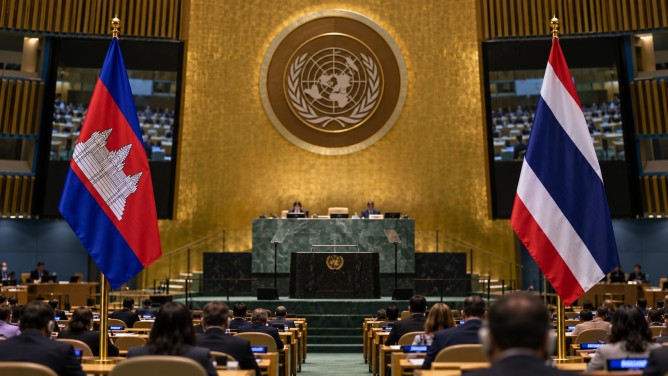
At the United Nations General Assembly, Cambodia and Thailand reiterated their opposing stances on a long-standing border dispute, each accusing the other of not doing enough to resolve the issue. Cambodian Foreign Affairs Minister Prak Sokhonn urged Thailand to adhere to existing bilateral agreements, resume border survey and demarcation activities, and facilitate the return of displaced civilians to their homes. Sokhonn emphasized that recent tensions have strained relations and affected both civilians and cultural heritage, advocating for both nations to honor past commitments and respect international law to rebuild trust.
The maritime dispute between the two countries remains unresolved, with Cambodia pursuing a resolution through international law. Sokhonn noted that Cambodia has initiated compulsory conciliation proceedings under the UN Convention on the Law of the Sea after Thailand withdrew from a 2001 Memorandum of Understanding that provided a framework for maritime boundary discussions. In contrast, Thai Prime Minister Anutin Charnvirakul stated that any conciliation should focus solely on maritime boundary delimitation and called for Cambodia to engage in genuine bilateral dialogue to restore trust.
Both nations emphasized the need for cooperation, with Anutin advocating for collaboration on border security, demining, and combating online scam networks. Despite avoiding renewed armed conflict since a ceasefire ended a 21-day standoff last year, diplomatic tensions persist due to ongoing disagreements over the border and related issues.
At the UN, both Cambodia and Thailand highlighted the importance of international cooperation and peaceful dispute resolution. While Cambodia called for the adherence to international law and existing agreements to address disputes, Thailand favored bilateral efforts to enhance cooperation on security and other cross-border concerns. The discussions underscore the necessity for continued diplomatic engagement to resolve their differences.