
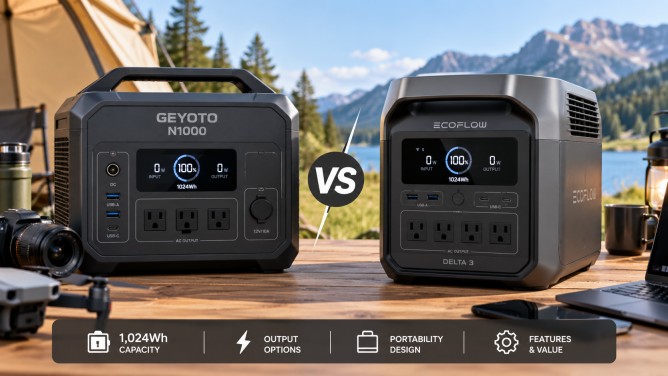
The GEYOTO N1000 and EcoFlow DELTA 3 Classic, two portable power stations with a 1,024Wh capacity and 1,800W AC output, are both designed to serve as reliable sources for home backup, outdoor adventures, and emergency power needs. While they share similar battery chemistry using LiFePO4 and offer comparable performance in continuous power delivery, the differences lie in their connectivity options, solar charging capabilities, portability, and vehicle support. The GEYOTO N1000 emphasizes flexible connectivity and higher solar input, while the EcoFlow DELTA 3 Classic is noted for its surge capacity and portability.
In terms of connectivity, the GEYOTO N1000 provides a broader range of options, including four USB-C ports, two USB-A ports, a 25W wireless charging pad, and a 12V DC output for vehicle applications, making it ideal for users with diverse device needs. On the other hand, the DELTA 3 Classic, with its six AC outlets and simpler connection layout, may suffice for those primarily looking to power AC devices. When it comes to portability, the DELTA 3 Classic takes the lead with its lighter weight of approximately 12.1kg compared to the N1000’s 13.6kg, though the N1000 is designed with robust exterior features for outdoor use.
Solar charging is another area where these power stations differ significantly. The GEYOTO N1000 can handle up to 800W of solar input, offering an advantage for those relying on solar power during prolonged outages, whereas the DELTA 3 Classic supports up to 500W. Both models achieve 80% charge in under 45 minutes when using AC power, demonstrating their efficiency for quick recharging. For high-draw appliances, the DELTA 3 Classic’s higher surge output of 3,600W, with X-Boost function supporting up to 2,600W, provides an edge over the N1000’s 3,000W peak output.
When it comes to smart features and emergency readiness, the EcoFlow DELTA 3 Classic incorporates the Storm Guard function, which can automatically initiate charging following severe weather alerts. This feature could be advantageous for users who keep their power station connected as part of a home emergency setup. Conversely, the GEYOTO N1000 offers additional hardware features, such as emergency lighting and SOS capabilities, alongside its extensive connectivity options. Thus, the choice between these two power stations depends heavily on user priorities: the N1000 for broader connectivity and solar input, or the DELTA 3 Classic for its lighter design and advanced surge and weather-related features.
Ultimately, both the GEYOTO N1000 and EcoFlow DELTA 3 Classic are designed to meet specific needs, offering a blend of power, portability, and functionality. The N1000 stands out for scenarios requiring diverse connectivity and higher solar capacity, such as camping or vehicle support, while the DELTA 3 Classic appeals to those valuing compact design and enhanced surge performance. Users should consider their specific requirements for home backup, remote work, and outdoor activities to determine which model best suits their needs.
Legal Disclaimer:
The information contained in this article has been provided by independent third-party contributors, clients, or content partners. We do not independently verify the accuracy, completeness, legality, ownership, licensing, or reliability of submitted content, including text, images, videos, trademarks, or other media materials. The submitting party is solely responsible for ensuring that all content, including images and media assets, complies with applicable copyright, trademark, licensing, and intellectual property laws. We disclaim liability for any unauthorized use of copyrighted or proprietary materials by third parties. If you believe that any content published on this platform infringes your intellectual property rights, kindly contact the author above for prompt review and resolution.